Please visit ICPR Facebook page for latest announcements on ICPR!
Pre-Conference Programmes
Webinars (2025-2026) & Pre-Conference Workshops (6 July 2026)
On-going: Webinars
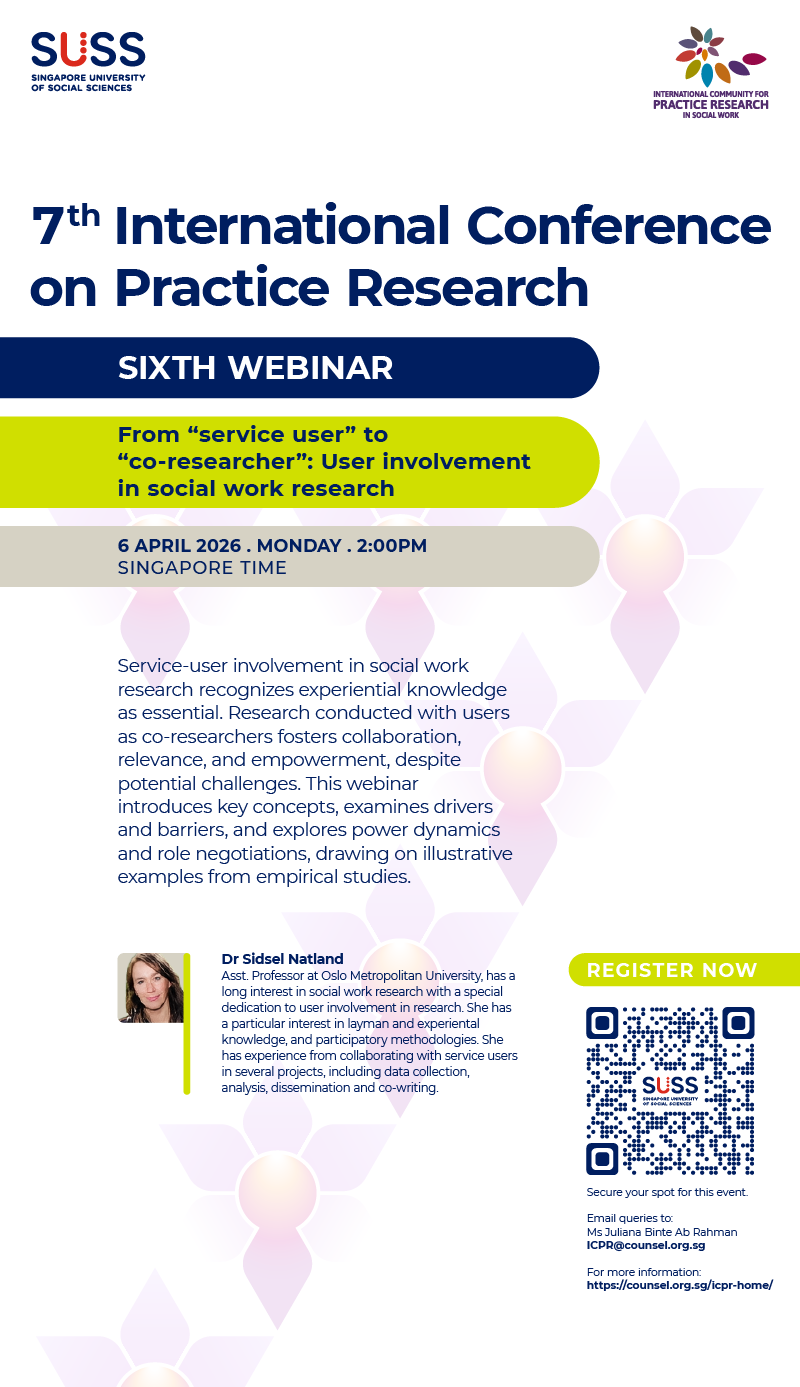
In the lead-up to the July 2026 conference, 6 complimentary webinars will be conducted between 2025 and 2026, providing an introduction to the fundamentals of practice research and exploring the various pathways for engaging in practice research.
All timings mentioned are in Singapore Time (SGT).
Participants can choose two workshops (1 in the morning and 1 in the afternoon) from a total of 6 available options.
This dynamic workshop series offers diverse, in-depth learning opportunities for researchers, practitioners, and students engaged in practice research.
Spanning theoretical, methodological, and applied topics, the workshops explore innovative approaches to participation, qualitative inquiry, randomized trials, therapist effectiveness, and culturally grounded therapeutic models.
Sessions range from reflections on decades of clinical experience to data-driven evaluations of emerging practices across global contexts.
Whether you’re new to practice research or looking to deepen your expertise, this series supports critical thinking and practical application in real-world settings.
1. Pre-Conference Practice Research Institute (Full day: 10am to 5pm)
Speaker:
Prof. Bowen McBeath,
Portland State University
This workshop supports junior scholars and senior practitioners in deepening their understanding of core and emerging approaches to practice research. Participants engage in small group consultations to receive feedback on works-in-progress and participate in peer learning. The session also provides networking opportunities to explore shared interests and introduces strategies for initiating and sustaining collaborative research projects, alongside new methods and theories. Registrants will be requested to share their abstract, CV, and brief application that identifies their relevant substantive, methodological, and theoretical background. Registrants will also be required to post their work-in-progress to a Google Folder for all participants to review before their respective morning small group consultation to facilitate meaningful and enriching consultation session.
2. Reimagining qualitative practice research with Gen AI (2pm- 5pm)
Speakers:
Prof. Christa Fouché and Prof. Laura Chubb,
University of Auckland
The Speakers will present findings from a scoping review on how participation is operationalised in practice-based research, focusing on how researchers invite, engage, and sustain involvement. The session will highlight both common and discipline-specific approaches. Attendees will then share their own experiences across three key areas: symbolic vs. substantive empowerment, creating and disseminating outputs, and measuring participation.
3. Theorising from Practice: Qualitative Approaches (2pm-5pm)
Speaker:
Dr Sui Ting Kong,
Durham University
Focusing on theorising from and for practice, this workshop explores the use of administrative data, experiential knowledge, and practice wisdom in social work. Dr Sui will present examples from Hong Kong and the UK using Cooperative Grounded Inquiry, Interpretive Phenomenological Analysis, and Thematic Analysis. Participants will take part in world café sessions for hands-on experience with two theorising approaches, aiming to build understanding, explore qualitative methods, and develop practical analysis skills.
4. How to Use Randomized Experiments to Evaluate Social Work Practice Outcomes (1Oam- 1pm)
Speaker:
Prof. Bruce Thyer,
Florida State University
Gain practical guidance on designing and implementing randomized controlled trials (RCTs) within social work settings. Learn how to evaluate the effectiveness of interventions using experimental methods, with attention to ethical considerations, contextual challenges, and relevant outcome measures. Through real-world examples and interactive discussion, the session demystifies RCTs and offers tools to conduct and critically assess rigorous evaluations in practice-based environments.
5. Understanding Therapists Effects: Why Are Some Therapists Better Than Others? (10am- 1pm)
Speaker:
Prof. Rick Miller,
Brigham Young University
By the end of the workshop, participants will understand the concept of therapist effects—the significant variation in effectiveness among therapists—and what research has revealed (and not yet revealed) about what distinguishes more effective therapists. The session will also briefly connect this topic to its foundation in practice research, highlighting its relevance and importance in that context.
6. Strengthening Health Social Work practice research through the Academic–Practitioner Model (10am- 1pm)
Speakers:
Prof. Lynette Joubert,
The University of Melbourne
Dr. Lee Geok Ling,
National University of Singapore
Explores how the Academic–Practitioner Model can strengthen health social work research by fostering effective collaboration between researchers and practitioners. Learn practical strategies to bridge theory and practice for greater impact.